
Can AI Help Breeders Make Better Decisions?
Breeding will always involve uncertainty. The opportunity for artificial intelligence is not to manufacture certainty, but to help breeders evaluate a complicated decision more completely before committing a mare.
Few decisions in horse racing involve more uncertainty than selecting a mating.
A breeder must commit time, money, and a year of a mare's reproductive life to a decision whose true outcome may not be known for several years.
By the time the foal reaches the racetrack, the commercial market may have changed, the stallion's reputation may have risen or fallen, and the horse itself may develop differently than anyone expected.
That uncertainty is why breeding has always required both art and analysis.
There Is No Single Variable That Defines a Good Mating
Pedigree, physical traits, performance, market demand, cost, family history, and long-term goals may all influence the decision.
None of those factors can guarantee the result.
Successful matings sometimes disappoint, while seemingly ordinary combinations occasionally produce exceptional horses.
Artificial intelligence cannot remove that uncertainty, and it should never be presented as a machine that can manufacture champions.
Its value is more practical.
Breeding requires a person to consider many different kinds of information at the same time, and AI can help organize that complexity so the breeder can evaluate the decision more completely.
The Hard Part Is Deciding What Matters
The difficulty in breeding is rarely a total lack of information.
The difficulty is deciding which information matters, how much weight it deserves, and how it relates to the breeder's objective.
A mating intended to produce a commercial weanling may need to be evaluated differently from one intended to produce a racehorse to retain.
A breeder seeking immediate market appeal is solving a different problem from an owner-breeder planning several generations ahead.
Artificial intelligence cannot determine which goal is correct.
That responsibility belongs to the breeder.
Start With the Objective
What AI can do is help keep the analysis aligned with the goal once that goal has been clearly defined.
This distinction matters because breeding recommendations can sound convincing while answering the wrong question.
A stallion may be an attractive option in general but unsuitable for a specific mare, budget, market, or business plan.
A fashionable mating may offer significant upside while carrying more risk than the breeder intends to accept.
Another mating may appear less exciting but provide a better balance between cost, marketability, and the probability of producing a useful horse.
This is why Horse Sense begins with the mare rather than treating the stallion as the starting point of the decision. The female family , the mare's physical type, her produce record, and her commercial position establish the foundation from which the mating should be evaluated.
AI Can Help Compare the Tradeoffs
A useful AI system should help the breeder compare those tradeoffs without pretending that one answer is certain.
It should support judgment by organizing relevant evidence, identifying areas that deserve attention, and testing whether the reasoning remains consistent with the breeder's stated purpose.
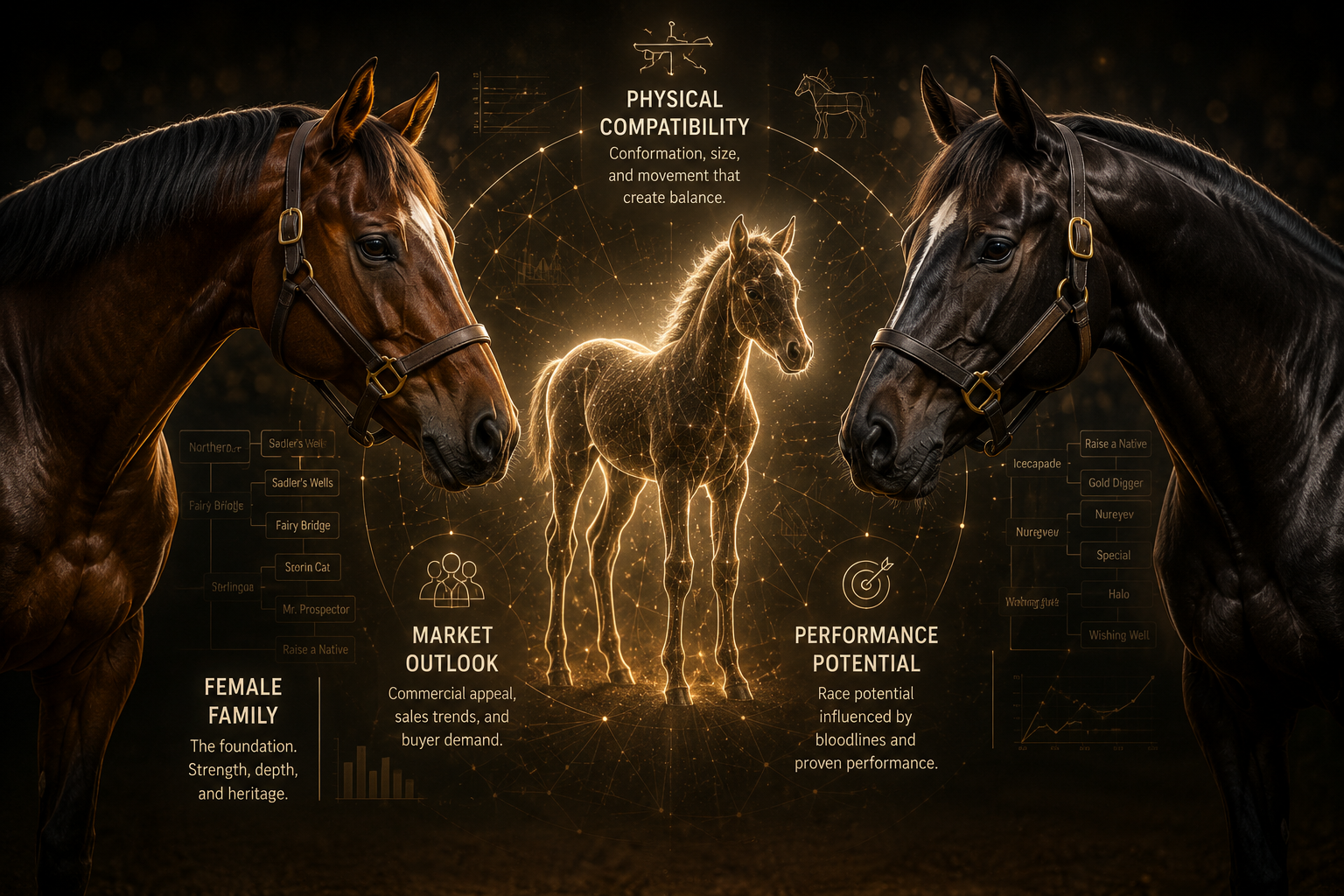
That is also the purpose of the Horse Sense mating analysis process . Pedigree support, physical compatibility, female-family strength, stallion stage, market supply, commercial risk, and expected sale position can be considered together rather than allowing one attractive pedigree pattern to determine the entire mating.
Pedigree Is Only Part of the Decision
Traditional breeding analysis often begins with the pedigree because pedigree information is readily available and relatively easy to compare.
But a pedigree that looks attractive on paper does not automatically mean the resulting horse will be physically compatible with the mare or commercially positioned for the breeder's intended market.
This is one reason Horse Sense distinguishes between statistical pedigree analysis and traditional pedigree analysis .
Historical patterns can provide useful evidence, but they should be interpreted within the broader context of the mare and the objective of the mating.
The Market Is Part of the Breeding Decision
For commercial breeders, the mating decision cannot end with the pedigree.
The stallion's current demand, expected crop size, sales performance, stage of his career, stud fee, and the likely sale environment when the resulting foal reaches the market all matter.
A mating may be genetically attractive and still present significant commercial risk.
Conversely, a fashionable commercial stallion may not compensate for the mare or may expose the breeder to a market crowded with hundreds of similarly bred horses.
That is where Thoroughbred sales analytics and bloodstock value forecasting become part of the mating discussion rather than separate exercises performed after the breeding decision has already been made.
AI Should Add Another Perspective, Not Replace the Advisors
None of this diminishes the importance of experienced advisors.
Breeders will continue to depend on veterinarians, farm managers, bloodstock professionals, pedigree analysts, stallion farms, and other horsemen whose practical knowledge cannot be replaced by software.
Artificial intelligence should add another perspective to that group rather than attempt to take control of the decision.
The breeder remains responsible for understanding the mare, choosing the objective, deciding what level of risk is acceptable, and determining which recommendation makes practical sense.
AI can assist with analysis.
It cannot assume ownership of the outcome.
Breeding Is Exactly Where False Certainty Becomes Dangerous
That distinction is especially important in breeding, where certainty is impossible and every decision ultimately involves judgment.
A mating recommendation that presents itself as an absolute answer can create more confidence than the evidence deserves.
Better analysis should do the opposite.
It should identify where the evidence is strong, where the assumptions are weaker, what risks remain, and why one option may be preferred over another.
The objective is not to make uncertainty disappear.
It is to understand the uncertainty before money and time are committed.
AI Can Challenge Familiar Breeding Habits
The greatest benefit may be the ability to examine decisions more deliberately.
Familiar stallions, successful past matings, market fashion, and personal preferences can all influence how breeders think.
Those influences are not inherently wrong, but they should be examined rather than accepted automatically.
AI can help test whether the available evidence supports an initial opinion or whether another possibility deserves consideration.
That is where the thinking-partner concept becomes practical.
The Three Questions Still Apply
This is consistent with the three questions that should guide every meaningful use of AI in horse racing.
- Does it help the breeder make a better decision?
- Does it help avoid an expensive mistake?
- Does it help identify an opportunity that might otherwise have been overlooked?
If the answer is yes, artificial intelligence has a legitimate role in the breeding process.
Not because it knows how to breed a better horse.
Because it can help a knowledgeable breeder make a more complete and disciplined decision.
The Decision Happens Before the Mare Enters the Breeding Shed
Breeding will always involve uncertainty, intuition, and the possibility that an individual horse will defy every expectation.
Artificial intelligence will not change that.
What it can change is the quality of the decision made before the mare ever enters the breeding shed.