
AI-Assisted Review
Model output is translated into a clear decision memo that explains pedigree signal, important outliers, key drivers, risks, and conclusions in direct language.
Decision-ready synthesis
Horse Sense supports Thoroughbred buyers, sellers, breeders, and advisors with structured pedigree analysis, variance-aware pricing, and disciplined breeding strategy grounded in real market behavior.
.jpg)
Model output is translated into a clear decision memo that explains pedigree signal, important outliers, key drivers, risks, and conclusions in direct language.
Decision-ready synthesisFemale-family structure is evaluated alongside produce history, sire cycle, and market context to identify strength that persists across generations.
Repeatable family strengthCommercial outcomes are considered as realistic ranges, not single-point predictions, so uncertainty remains visible in buying, breeding, and sales decisions.
Variance-aware outcomesWe do not replace horsemanship. We strengthen it with structure.
Equine evaluation has always relied on trained eyes, practical experience, and knowledge built over time. Those remain essential.
Horse Sense adds structure to that judgment by evaluating pedigree, performance, family history, physical context, and market behavior within a consistent analytical framework.
The purpose is not to turn horsemanship into a formula. It is to make the evidence behind a decision clearer and reduce the influence of avoidable bias.
Better information should strengthen judgment, not compete with it.Relevant pedigree, family, physical, commercial, and market information is evaluated through a consistent framework rather than in isolation.
Analytical results are considered alongside physical assessment, sale conditions, breeding intent, and practical industry knowledge.
The analysis is ultimately designed to support breeding, buying, selling, and capital decisions that have real consequences.
A historical example showing how forecast ranges, physical assessment, and final sale prices can be evaluated together. The purpose is not to demonstrate perfect prediction, but to show how structured modeling and horsemanship can work together.
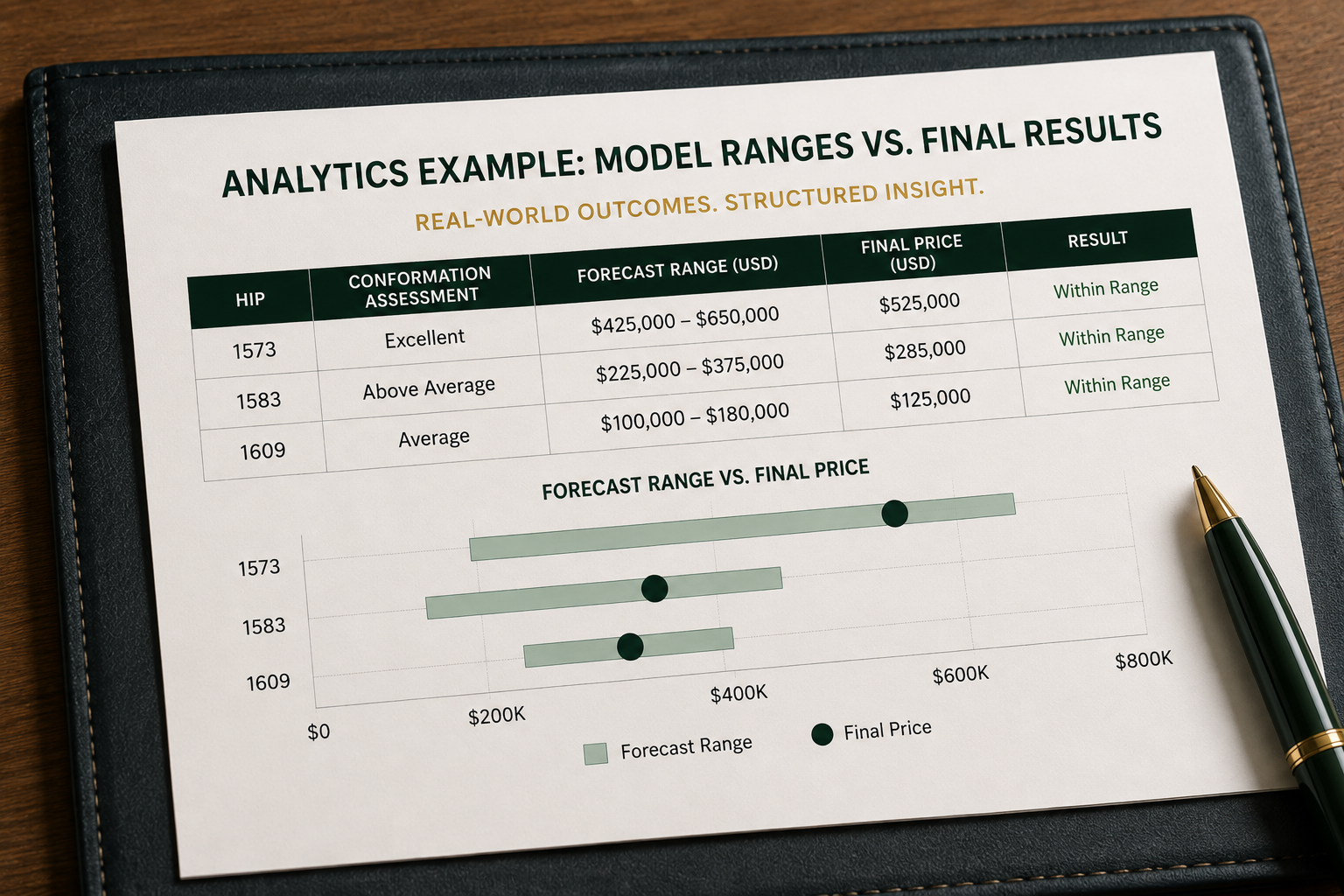
Evaluated as excellent condition. Final price aligned with the projected range.
Identified as above average. Sold within the modeled distribution, supporting the use of range-based pricing.
Assessed as average. Hammer price tracked closely to the baseline forecast.
When data and horsemanship operate together, the range becomes easier to interpret and the decision becomes easier to defend.
Thoroughbred decisions are made under uncertainty. Analytics cannot remove that uncertainty, but it can make the assumptions, risks, and tradeoffs more visible.
The mare or individual horse establishes the starting point. The analysis should respond to that horse rather than force every decision into the same preferred pattern.
In breeding decisions, the mare provides the base. Stallion selection should strengthen what is already there, address meaningful weaknesses, and fit the intended outcome.
Commercial markets contain too much variation for a single number to represent certainty. A realistic range provides a better framework for evaluating both risk and opportunity.
A pedigree or mating can be theoretically attractive and still make little sense once total capital, sale timing, market demand, and realistic resale are considered.
Analytics should improve the quality of the evidence. The final judgment still belongs to the horseman, breeder, buyer, or advisor responsible for the outcome.
Start an analysis or review the methodology behind Horse Sense pedigree, physical, female-family, commercial-range, and risk analysis.