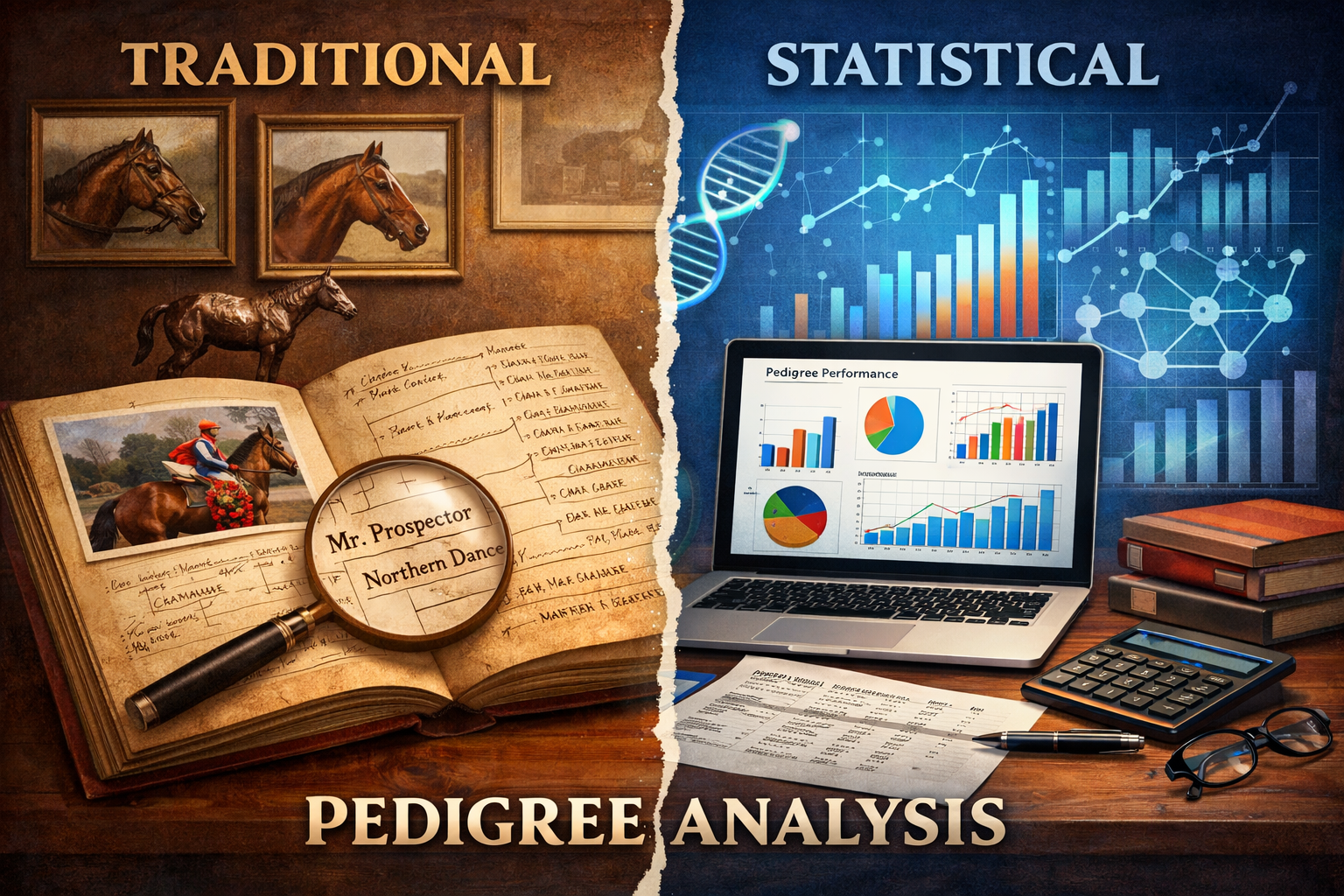

Pedigree Analysis Perspectives

Statistical vs. Traditional Pedigree Analysis

Two approaches. One better decision.

Traditional pedigree analysis interprets patterns through experience. Statistical analysis measures outcomes and probability. The strongest decisions use both in the right order.

Statistical data and traditional Thoroughbred pedigree analysis
Side-by-Side Comparison

Different Questions. Different Starting Points.

Both methods add value. The important distinction is understanding what each approach does well, what it cannot establish on its own, and when it should enter the decision.

Traditional Analysis

Narrative-First

Begins with an interpretation of how the pedigree, family, or mating should work.

  • Uses pattern recognition and accumulated experience
  • Evaluates linebreeding, inbreeding, sire-line relationships, and pedigree structure
  • Draws on historical analogs and notable runners
  • Incorporates reputation, intuition, and practical horse knowledge
  • Helps interpret physical and structural compatibility
Typical Question Why should this mating work?

VS

Statistical Analysis

Probability-First

Begins with measurable outcomes and asks what the available evidence actually supports.

  • Establishes base rates before forming conclusions
  • Measures repeatable outcomes rather than isolated examples
  • Evaluates ranges, variance, and downside exposure
  • Tests whether observed patterns outperform relevant baselines
  • Makes uncertainty part of the decision instead of hiding it
Typical Question What does the evidence say is likely?
Certainty vs. Probability

A Good Story Can Still Be a Weak Probability

Traditional pedigree analysis is powerful because experienced horsemen can recognize patterns that are difficult to reduce to a single number. The weakness appears when a compelling explanation begins to feel more certain than the evidence actually supports.

A famous ancestor, successful nick, or memorable runner can make a mating feel obvious even when the underlying sample is small or the success has not repeated consistently.

Traditional “Will this work?”
Statistical “What range of outcomes does the evidence support?”
The Better Workflow

A Practical Way to Use Both

The strongest process is sequential rather than ideological. Statistics and traditional judgment solve different parts of the same problem.

Start With Evidence

Establish the Base Rate

Evaluate production history, female-family depth, cross performance, sire evidence, and market behavior before becoming attached to a mating theory.

Remove options the evidence does not support.
Apply Horsemanship

Use Traditional Judgment

Within the viable group, evaluate physical quality, structural compatibility, pedigree construction, individual characteristics, and the needs of the mare.

Select the mating that best solves the mare's problem.
Validate the Decision

Return to the Evidence

Test the preferred mating against commercial range, market position, total exposure, sale strategy, and the risks identified during the evaluation.

Confirm that the final decision still makes sense.
Context Still Matters

Neither Approach Is Complete on Its Own

Each method has failure points. Recognizing those limitations is part of using the tools correctly.

Where Traditional Analysis Can Break Down

  • Small sample distortion. One exceptional runner can create confidence that the broader population does not support.
  • Survivorship bias. Successful examples are remembered while ordinary and unsuccessful outcomes receive less attention.
  • Reputation inflation. Famous names can feel predictive even when they are increasingly distant from the producing generation.
  • Narrative drift. “Should add” can gradually become “will add” without additional evidence.

Where Statistical Analysis Can Break Down

  • Weak datasets. Thin or poorly structured samples can produce unstable conclusions.
  • False precision. A clean score or percentage can appear more certain than the underlying evidence warrants.
  • Individual context. Historical data cannot fully evaluate the individual horse standing in front of you.
  • Unmeasured variables. Veterinary, management, development, and physical factors may materially affect the outcome.
The Horse Sense Balance

The Mare Establishes the Base. The Stallion Is the Lever.

Horse Sense begins with the mare because her physical profile, race history, produce record, female-family strength, and existing pedigree structure establish the starting point for the mating.

Statistical analysis helps identify what that base has repeatedly produced and which options deserve consideration. Traditional judgment then helps determine which stallion best complements the individual mare.

The final mating is returned to commercial and statistical analysis to determine whether the expected opportunity justifies the exposure.

Explore the Horse Sense Methodology →
Foundation The Mare
+
Improvement The Stallion
=
Objective Better Mating Decision
Practical Application

Decision Rules You Can Apply Immediately

The amount of evidence required should change with the mare, the mating, and the capital being exposed.

Light Page

Demand stronger supporting evidence, maintain tighter fee discipline, and control commercial downside.

Deep Female Family

Strong repeatability can support additional commercial ambition, but exposure still needs to be priced realistically.

Rare Cross

Treat limited direct evidence carefully and look for support from adjacent pedigree and production patterns.

Commercial Plan

Prioritize liquidity, realistic sale placement, buyer behavior, and expected return rather than pedigree elegance alone.

Exposure Check

Validate the mating against expected range, most likely outcome, commercial ceiling, and total capital exposure.

The Takeaway

Use Both. In the Right Order.

Traditional analysis helps distinguish among viable options. Statistical analysis helps prevent weak options from reaching the table in the first place.

Combined in the right order, they produce disciplined judgment grounded in evidence rather than optimism alone.

The objective is not to make the data replace judgment. It is to give judgment better information.
From Analysis to Decision

Better Information. Better Breeding Decisions.

Use probability to establish what deserves consideration, horsemanship to identify the right fit, and market analysis to confirm that the final decision makes sense.