
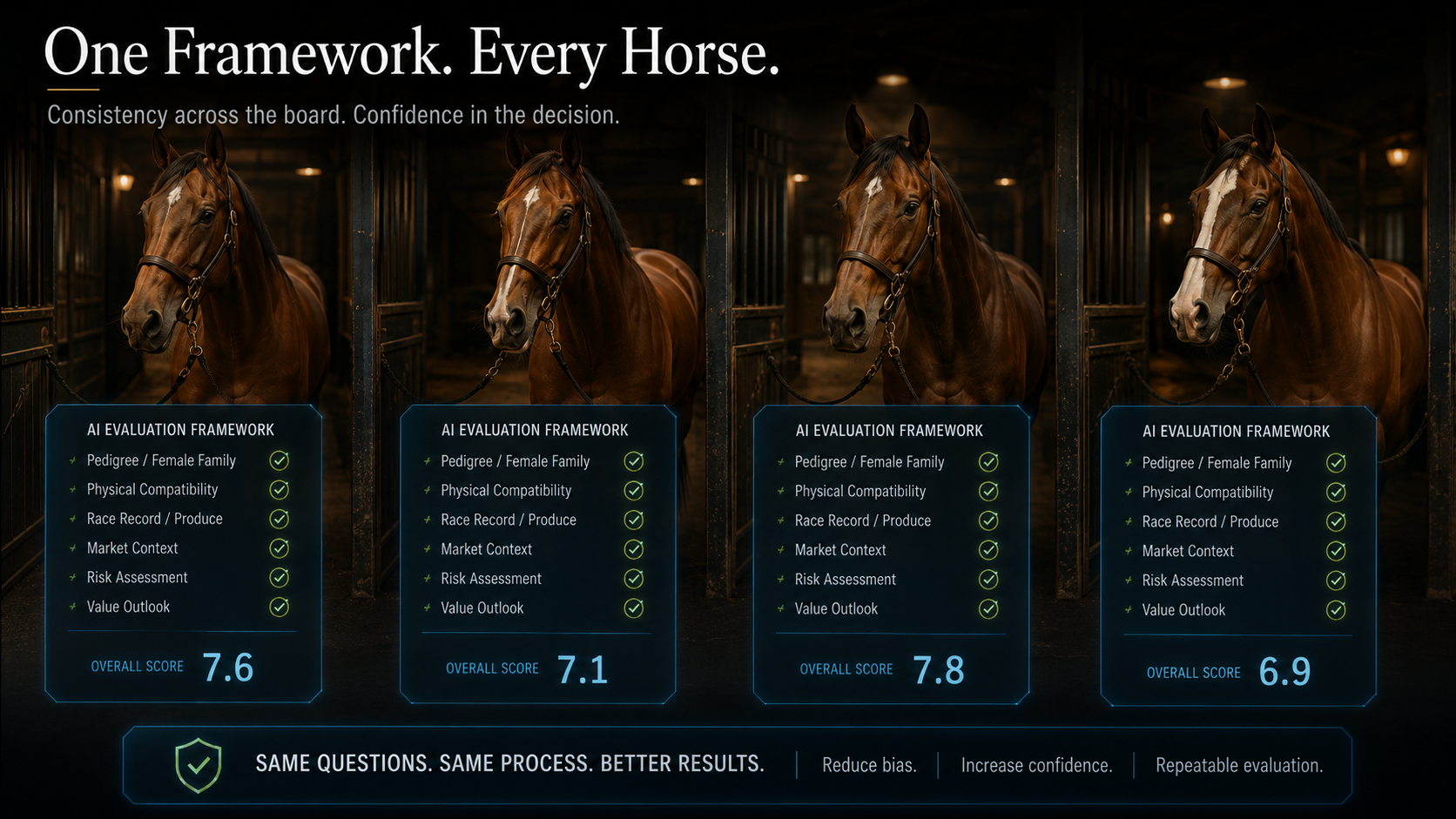
Better Decisions Require Better Standards
Good judgment becomes more useful when it is applied through a consistent process. Artificial intelligence can help make that process more repeatable without removing the horseman's judgment.
If you ask ten experienced horsemen to evaluate the same horse, you will almost certainly hear some common observations.
Most will recognize the obvious strengths and weaknesses, but beyond that, opinions often begin to separate.
One evaluator may place greater emphasis on balance. Another may focus on athleticism. A breeder may think about long-term genetic value, while a trainer may be more concerned with how the horse is likely to perform over the next twelve months.
Those differences are not necessarily mistakes.
They reflect the fact that every evaluator brings a unique set of experiences and priorities to the process.
The challenge is not that horsemen disagree. The challenge is that important decisions often deserve more consistency than they receive.
Consistency Matters When Decisions Must Be Compared
Imagine a farm evaluating one hundred yearlings over the course of a season.
If each horse is assessed using a different process, different priorities, or different standards depending on who happened to inspect it that day, comparing those evaluations becomes difficult.
Two excellent evaluators may reach different conclusions for perfectly valid reasons, but the business still has to decide which horse to buy, which horse to sell, or which horse deserves additional investment.
That is where a consistent framework becomes valuable.
Successful Organizations Build Systems
That is why successful organizations develop systems.
The best trainers follow consistent conditioning programs. The best veterinarians use established diagnostic procedures. The best breeders develop repeatable methods for evaluating matings, mares, and stallions.
Consistency does not eliminate judgment.
It creates a framework in which judgment can be applied more effectively.
That same principle is central to the Horse Sense evaluation process , where the objective is to review the same major categories of evidence before reaching a recommendation rather than allowing one attractive factor to dominate the entire decision.
AI Needs Standards Too
Artificial intelligence follows the same principle.
One of the biggest misconceptions about AI is that it simply looks at data and produces an answer.
In reality, AI performs best when it is given a clear process to follow.
If the instructions are vague, inconsistent, or incomplete, the conclusions will usually reflect those weaknesses.
If the process is thoughtful and well defined, the results become far more reliable.
This Is Really a Lesson About Decision-Making
That principle extends beyond artificial intelligence because it is really a lesson about decision-making.
Whether a horse is being evaluated by an experienced breeder, a bloodstock agent, or an AI system, the quality of the conclusion depends heavily on the quality of the process used to reach it.
Good decisions rarely happen by accident.
They are usually the result of asking the right questions in the right order, gathering the appropriate information, and evaluating it against consistent standards before reaching a conclusion.
Every Horse Deserves the Same Quality of Evaluation
That does not mean every horse should receive the same answer.
It means every horse deserves the same quality of evaluation.
One horse may present greater physical risk. Another may have a stronger female family. One mating may carry a better commercial ceiling. Another may offer better long-term racing potential.
The answers should change because the horses and circumstances are different.
The evaluation process should not change simply because the evaluator is rushed, distracted, or approaching the decision differently that day.
Standardization Does Not Mean Reducing Horses to a Formula
There will always be room for intuition, experience, and healthy disagreement.
Horse racing is far too complex to reduce every decision to a formula, and that is part of what makes the industry so interesting.
The goal is not to remove human judgment.
The goal is to make human judgment more consistent.
This distinction is especially important when comparing statistical and traditional pedigree analysis . A statistical framework can create consistency, but it still needs the interpretation of someone who understands the horse, the mare, the market, and the limitations of the evidence.
AI Can Help Prevent Important Factors From Being Overlooked
Artificial intelligence has an important role to play because it does not become distracted, rushed, or inconsistent from one evaluation to the next.
When given a well-designed process, it can approach each horse in the same way, ask the same categories of questions, and review the same types of information before presenting a conclusion.
The horseman still decides what matters most.
But AI can help ensure that important factors are not overlooked simply because the process changed from one evaluation to the next.
Consistency Becomes More Valuable at Scale
That may sound like a small improvement, but in practice it can become a major competitive advantage.
A breeder evaluating two matings may be able to keep every relevant factor in mind.
A farm evaluating dozens of mares, a bloodstock agent reviewing hundreds of sale horses, or a consignor managing a large sales draft faces a different problem.
As the number of decisions increases, consistency becomes more difficult and more valuable.
That is also why structured Thoroughbred sales analysis can be useful. The purpose is not to produce an automatic answer for every horse, but to make sure comparable commercial evidence is evaluated consistently before the buyer or seller makes the final decision.
Repeatable Good Decisions Build Successful Programs
The best decisions are rarely the result of one brilliant insight.
More often, they are the product of a disciplined process repeated consistently over time.
Horse racing has always rewarded good judgment.
Artificial intelligence has the potential to make good judgment more repeatable.
And repeatable good decisions are what build successful farms, successful racing stables, and successful breeding programs.