
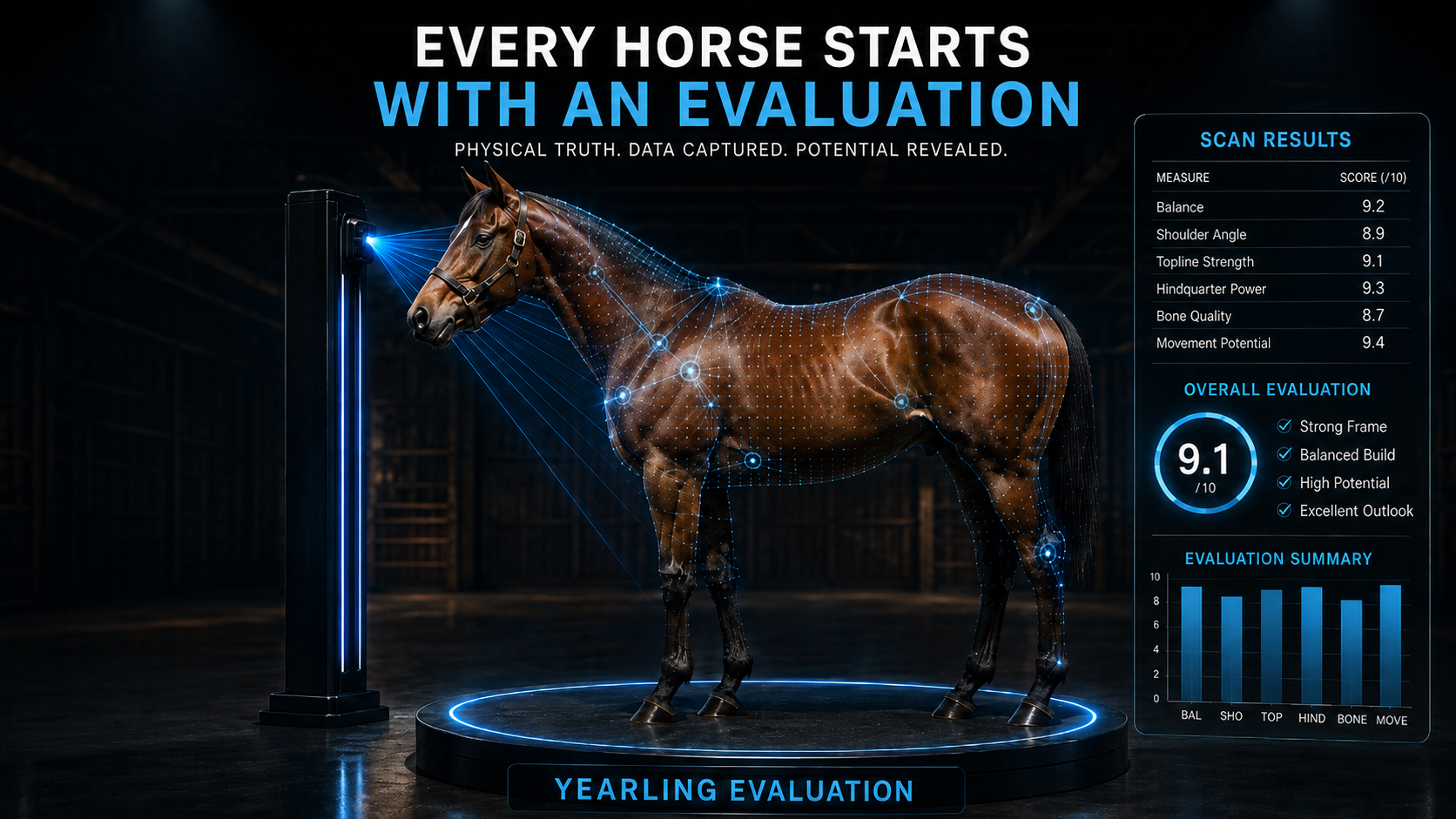
Every Horse Starts With an Evaluation
Before the pedigree, market, training plan, or breeding recommendation matters, someone has to understand the horse standing in front of them.
Every important decision in horse racing begins with an evaluation.
Before a breeder chooses a stallion, they evaluate the mare. Before a buyer raises a hand at a sale, they evaluate the horse. Before a trainer develops a conditioning program, they evaluate the athlete standing in front of them. Before a veterinarian recommends treatment, they evaluate the horse's physical condition.
Everything begins with understanding what you are looking at.
Horse Evaluation Is Difficult to Standardize
That may sound simple, but horse evaluation is one of the most difficult skills in the industry to master.
Ask ten experienced horsemen to evaluate the same yearling and you will likely receive ten slightly different opinions.
Most will agree on the obvious strengths and weaknesses, but the finer details often reflect differences in experience, priorities, and perspective.
One evaluator may see athletic potential. Another may focus on commercial appeal. A breeder may immediately think about long-term genetic value, while a trainer may picture how the horse will move under saddle.
None of those opinions is necessarily wrong.
They simply represent different ways of looking at the same horse.
Evaluation Has Always Been Both Art and Science
That diversity of opinion has always been one of the strengths of horse racing.
It reflects the fact that evaluating horses is both an art and a science.
Experience matters. Judgment matters. Intuition matters.
The ability to recognize subtle details often comes only after years of working with horses.
Artificial intelligence should never replace those qualities.
Instead, it should strengthen them.
Which Evaluator Has the Advantage?
Imagine two experienced horsemen standing beside the same yearling.
Both have decades of experience. Both have developed a sharp eye for horses.
The difference is that one of them also has immediate access to thousands of comparable examples, historical commercial outcomes, race performance, pedigree information, veterinary research, and market trends that relate to the horse standing in front of them.
Which evaluator has the advantage?
The answer is not that one horseman is better than the other.
The advantage comes from having more relevant information available before forming an opinion.
AI Should Support the Evaluator
That is where artificial intelligence belongs.
Its value is not in making the evaluation.
Its value is in supporting the evaluator.
For generations, experienced horsemen have built mental libraries of horses they have seen. They remember exceptional individuals, disappointing purchases, successful families, and physical traits that proved meaningful over time.
Those memories become part of their judgment and help shape future decisions.
Artificial intelligence can expand that library.
AI Can Expand the Horseman's Reference Library
AI can help organize decades of information, surface relevant historical examples, identify patterns worth considering, and present evidence that might otherwise be overlooked.
It does not tell the horseman what to think.
It gives the horseman more to think about.
That approach is consistent with how Horse Sense evaluates a horse and mating : physical information is considered alongside pedigree, family, market, and commercial evidence rather than treating one category as the entire answer.
Horse Racing Will Never Become Completely Objective
That distinction is important because horse racing will never become completely objective.
There will always be exceptional horses that break every rule and ordinary-looking horses that become champions.
No amount of technology will eliminate uncertainty, and no algorithm will replace the instincts developed through years of experience.
Artificial intelligence is not valuable because it removes uncertainty.
It is valuable because it reduces unnecessary uncertainty.
Separate Evidence From Assumption
AI helps separate evidence from assumption.
It encourages horsemen to test long-held opinions against broader information.
Sometimes that information will confirm what experience already suggests.
Sometimes it will challenge it.
Both outcomes improve the decision-making process.
This becomes especially useful in Thoroughbred sales analysis , where physical evaluation still matters, but it can be considered alongside comparable horses, historical sale outcomes, stallion trends, and market behavior.
AI Can Help Horsemen See More Completely
Perhaps the greatest contribution AI can make is not changing how horsemen see horses.
It is helping horsemen see more completely.
Every evaluation is built on the information available at the time it is made.
The more complete that information becomes, the stronger the evaluation can become.
The horseman still provides the judgment.
Artificial intelligence simply helps ensure that judgment is supported by the broadest understanding possible.
The Horseman's Eye Still Matters
Every important decision in horse racing begins with an evaluation.
Artificial intelligence should not replace the horseman's eye.
It should help the horseman see more clearly.