
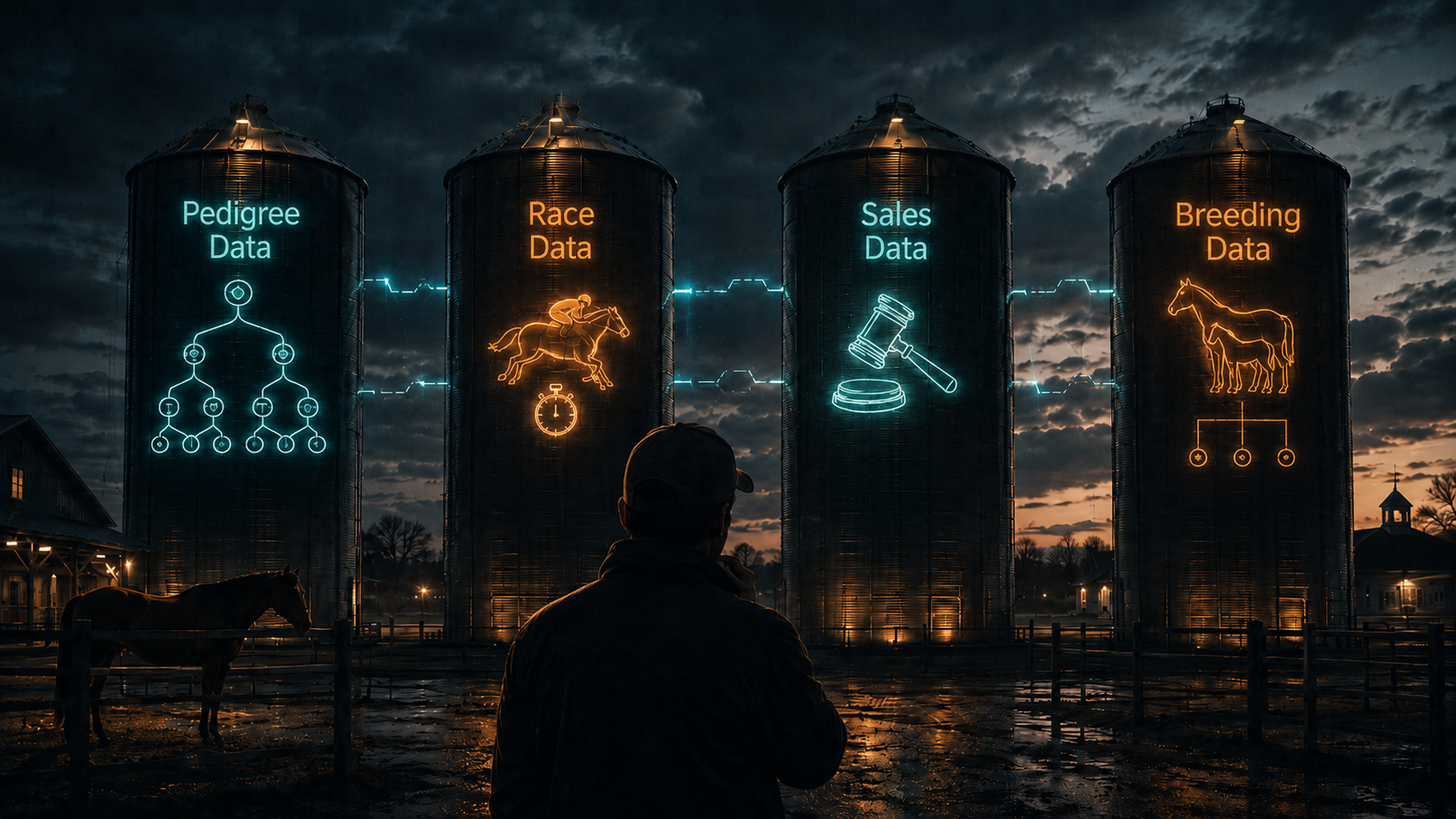
AI Cannot Use Data It Cannot Access
Artificial intelligence can only be as useful as the information it can reach. For horse racing, that makes data access one of the most important questions surrounding the next generation of technology.
The first three articles in this series established where artificial intelligence belongs in horse racing, how it should work with horsemen, and why access to knowledge has always been a competitive advantage.
That leads to a harder question:
What happens when the information AI needs is controlled, fragmented, or difficult to obtain?
Artificial intelligence cannot analyze data it cannot access. It cannot connect records locked inside separate systems, and it cannot discover patterns when the information required to test those patterns is unavailable.
The quality of an AI system depends not only on the people who build it, but also on the quality, depth, and accessibility of the information behind it.
Horse Racing's Information Is Fragmented
This creates a particular challenge for horse racing because much of the industry's factual information is concentrated within a relatively small number of organizations and commercial databases.
Race results, entries, charts, pedigrees, produce records, sales histories, speed figures, veterinary information, and other records are available in different forms, but access varies.
Some information is free. Some requires individual purchases or subscriptions. Some is licensed only under specific commercial arrangements.
That fragmentation is part of the reason pedigree analytics becomes valuable: important decisions often require several different forms of information to be considered together rather than one report at a time.
There Are Legitimate Reasons Data Costs Money
There are legitimate reasons for this.
Collecting, verifying, maintaining, correcting, and distributing industry information costs money.
Race charts do not assemble themselves. Pedigree databases require ongoing maintenance. Accurate records need people, systems, quality control, and long-term investment.
Organizations that perform that work should be able to recover their costs and support the infrastructure required to keep the information accurate.
However, that is only one side of the issue.
Much of the Underlying Information Is Created by the Industry
Much of the underlying information consists of facts generated by the industry itself.
A horse started in a race. It finished third. It earned a certain amount. It was bred to a particular stallion. A foal was born in a particular year.
These events involve owners, breeders, trainers, racetracks, farms, veterinarians, buyers, sellers, and customers throughout the industry.
That raises a difficult question:
When factual information is created through the participation of the entire industry, how much control should any one organization have over how that information is accessed and used?
This Is Not Simply a Debate About Free Data
This is not simply a debate over whether information should be free.
The more important issue is whether the structure surrounding that information encourages or restricts new ideas.
A breeder may be able to purchase a mare's produce record. A handicapper may be able to download a race chart. A bloodstock agent may subscribe to pedigree and sales databases.
Those products serve specific purposes.
Artificial intelligence, however, works differently.
It becomes most useful when large volumes of information can be connected, compared, and analyzed together.
AI Requires a Different Scale of Access
A person can manually review twenty race records or ten produce records.
An AI system may need to compare tens of thousands of records to determine whether a pattern is meaningful.
Access designed for one report at a time is not necessarily access that supports research, product development, or large-scale analysis.
This is where paywalls, restrictive licensing, automated-access limits, and disconnected systems can become more than inconveniences.
They can become barriers to innovation.
Horse Racing Needs People Willing to Build Better Tools
The concern is not that every piece of racing information must be made available without cost or restriction.
The concern is that an industry already struggling to attract investment and modernize its products should be careful not to make experimentation unnecessarily difficult.
Horse racing needs people willing to build better tools for breeders, trainers, owners, bettors, farms, racetracks, and veterinarians.
Those tools will require reliable information.
If acquiring that information is too expensive, too complicated, or too restrictive, only the largest organizations will have the resources to develop them.
That would preserve the existing information advantage rather than expanding it.
Data Access Is Also a Governance Question
The current debate surrounding The Jockey Club and its related organizations reflects a broader frustration about governance, control, and access within the industry.
Mike Repole's threatened legal action has brought additional attention to concerns that a small group of established organizations has too much influence over racing's structure and direction.
The threatened litigation is broader than data access alone, but it illustrates the pressure building around who controls the industry's institutions and whose interests those institutions serve.
The Industry Is Beginning to Recognize the Opportunity
At the same time, it would be incomplete to suggest that the industry is standing still.
The Jockey Club and Equibase have taken steps to expand access for research and development, including offering a complimentary historical dataset and, more recently, announcing a Thoroughbred Data Hub and innovation program intended to provide developers with access to racing and pedigree information.
Those developments are significant because they recognize that racing data is not valuable only as a product to be sold.
It can also serve as infrastructure from which new products, analysis, and businesses are created.
The Details Will Determine Whether Access Is Truly Useful
The real test will be how accessible, affordable, and practical those programs become.
A data initiative may sound open while remaining difficult for independent developers, smaller farms, researchers, or new companies to use.
The details of licensing, cost, coverage, technical access, and permitted uses will determine whether these programs genuinely encourage innovation or simply create another controlled doorway into the same information.
The Industry Does Not Need to Choose Between Two Extremes
The industry does not need to choose between giving everything away and locking everything down.
It needs a structure that recognizes two forms of value.
- The value created by collecting and maintaining accurate records.
- The value created when other people are allowed to build something useful from those records.
Both matter.
Different Uses Can Justify Different Terms
A workable system could protect proprietary reports, specialized analysis, and commercial products while making core factual data available through transparent and reasonably priced licensing.
It could distinguish between an individual researching a horse, an academic studying safety, a startup building a farm-management tool, and a major wagering company using real-time data commercially.
Different uses can justify different terms without treating every form of access as a threat.
The same principle applies to areas such as Thoroughbred sales analytics and bloodstock value prediction , where meaningful analysis depends on having enough historical information to compare patterns rather than relying on isolated examples.
Racing Data May Be More Valuable as Infrastructure
This matters because the future value of racing data may not come primarily from selling another report.
It may come from the businesses, research, and decisions that become possible when that data can be connected in new ways.
Artificial intelligence has the potential to help horsemen make better decisions, avoid expensive mistakes, and discover new opportunities.
But it cannot do that in a meaningful way if the information it needs remains isolated behind systems built for a different era.
The next competitive advantage in horse racing may not belong to the organization that controls the most data. It may belong to the industry that finds the best way to use it.