
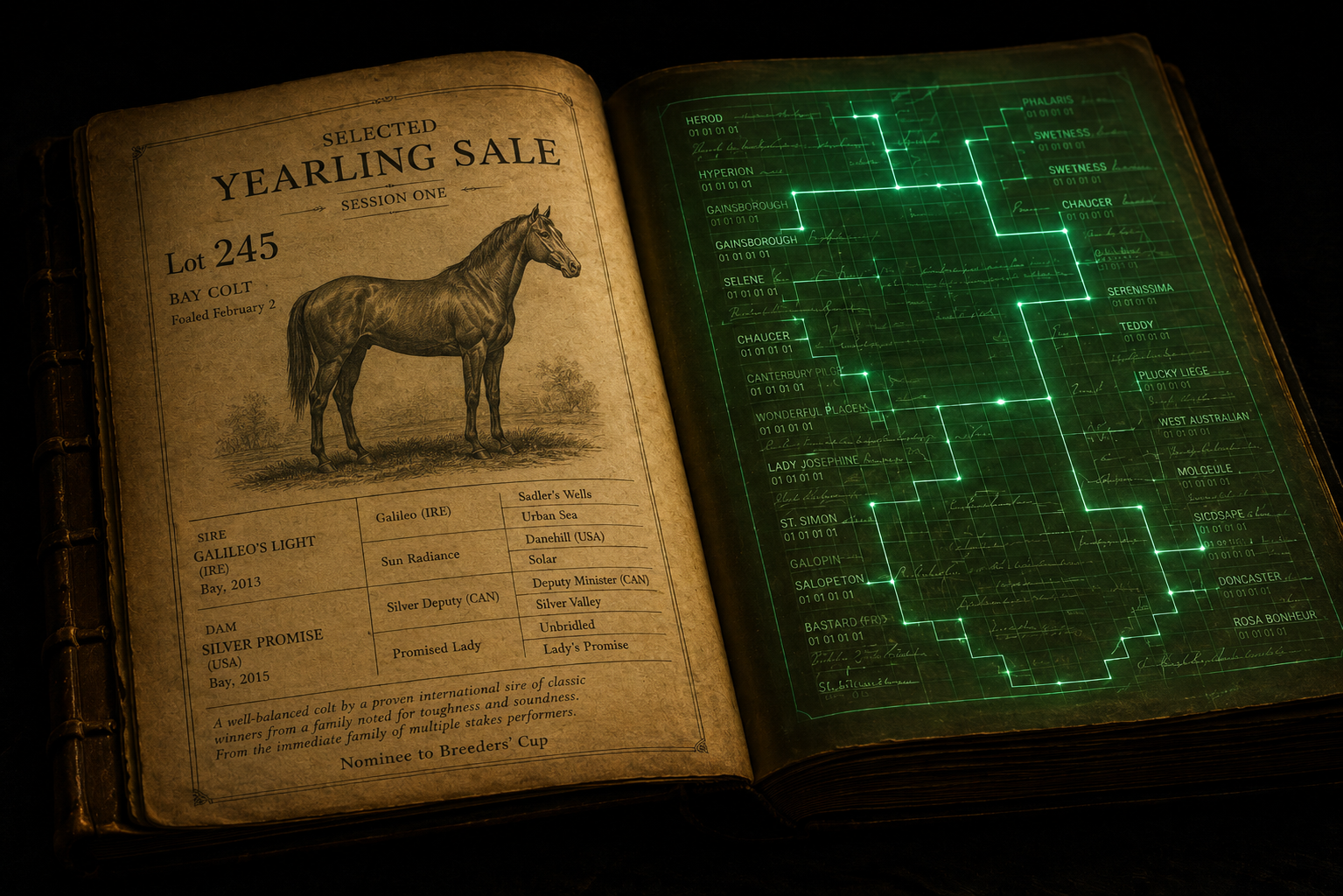
Knowledge Has Always Been Horse Racing's Greatest Competitive Advantage
Artificial intelligence does not create horsemanship. Its opportunity is to help horsemen organize, test, and apply a broader body of knowledge than any one person could realistically manage alone.
If artificial intelligence is going to become a thinking partner, it needs something to think with.
That something is not intelligence by itself.
It is knowledge.
For generations, one of the greatest competitive advantages in horse racing has been access to information. The best breeders, trainers, bloodstock agents, and farm managers built their reputations through years of experience, relationships, observation, and research.
They learned which sire lines consistently worked, which female families continued to improve, which farms developed better horses, and which market trends were worth following.
That knowledge was earned.
Expertise Has Always Been Built Over Time
It took years to accumulate that knowledge, and in many cases it remained closely held. Some of it was written down, some existed in databases, and much of it lived only in conversations, notebooks, or the minds of experienced horsemen.
There was nothing wrong with that. It is how expertise develops in every profession.
The challenge is that no individual can know everything.
Even the most accomplished breeder has not studied every mating. Every trainer has blind spots. Every bloodstock agent develops preferences based on personal experience. Every successful horseman carries opinions shaped by memorable horses, trusted mentors, and years of working in the industry.
Those opinions are valuable, but they are still opinions.
Some prove remarkably accurate, while others survive because no one has challenged them with enough evidence.
Artificial intelligence changes that equation, not because it replaces experience, but because it gives us a way to test experience.
AI Can Change the Economics of Knowledge
For decades, if a breeder wanted to know how a particular sire line performed with a certain female family, the answer often depended on who they knew, what subscriptions they had, and how much time they were willing to spend researching the question.
Experienced advisors became valuable because they had already done much of that work.
Artificial intelligence has the potential to change the economics of knowledge.
Instead of spending hours moving between pedigree databases, sales records, race results, produce records, photographs, videos, spreadsheets, and personal notes, AI can help organize that information around the question being asked.
That is one of the ideas behind pedigree analytics : bringing multiple forms of evidence together so they can be evaluated as part of one decision rather than as disconnected pieces of information.
That does not make AI the expert. It makes expertise easier to access.
AI Cannot Replace Thirty Years of Horsemanship
Artificial intelligence cannot replace thirty years of horsemanship.
It cannot feel how a horse walks out of its stall, recognize every subtle change in attitude, or replace the instincts that come from handling thousands of horses.
What it can do is give an experienced horseman access to a broader body of evidence than ever before.
It can also help newer horsemen ask better questions.
That may be one of the biggest changes artificial intelligence brings to horse racing.
Information Has Always Been a Competitive Advantage
Historically, information has often been a competitive advantage.
The people with the best access to knowledge usually made better decisions.
Artificial intelligence has the potential to lower that barrier by helping more people organize and understand the information that already exists.
That should not be viewed as replacing expertise.
It should be viewed as expanding it.
The experienced breeder still contributes judgment. The trainer still contributes observation. The veterinarian still contributes medical expertise. The bloodstock agent still contributes market knowledge.
Artificial intelligence helps bring those perspectives together with more information than any one person could realistically process alone.
Knowledge Becomes More Valuable When It Can Be Connected
The practical value of information increases when different forms of evidence can be compared together.
A pedigree may suggest one thing. The physical horse may suggest another. Historical sales data may change the commercial interpretation of the same mating. Stallion trends may reveal whether market demand is improving or becoming more selective.
This is why areas such as Thoroughbred sales analytics and bloodstock value prediction become more useful when they are connected to pedigree and horse-specific evaluation rather than considered in isolation.
The advantage does not come from having more numbers.
It comes from knowing which information matters to the decision being made.
Data Access Will Become Part of the AI Conversation
This also explains why access to information is becoming one of the most important conversations facing the industry.
Artificial intelligence cannot analyze information it cannot access, and it cannot discover patterns hidden inside data that remains isolated, fragmented, or unavailable.
As AI becomes more common, the industry will increasingly face questions about how factual information should be collected, shared, protected, and used to encourage innovation while respecting the investment required to create and maintain those databases.
Those discussions are important, but they should not distract from the larger opportunity.
The Real Value Is Turning Knowledge Into Better Decisions
The real value of artificial intelligence is not that it replaces knowledge.
The real value is that it helps more horsemen benefit from it.
For generations, horse racing rewarded those with the best access to information.
The next generation may reward those who know how to turn that information into better decisions.
That may become the greatest competitive advantage of all.